The position of the chin in relation to the rest of the face is just as important as its size.
The relationship between the chin, lower lip, nose, and forehead helps define the overall facial profile, particularly when viewed from the side.
The jawline is the lower facial contour extending from the chin to the angle of the lower jaw.
During an aesthetic facial assessment, the chin and jawline are evaluated together. The aim is to achieve a balanced appearance that complements each person’s natural facial proportions, rather than creating the same sharply defined jawline for everyone.
The chin is an important part of the lower third of the face.
Its forward projection, height, width, and shape are assessed in relation to the nose, lips, and neck.
For example, a recessed chin may make the nose appear larger or more prominent.
In some patients, improving chin projection can create a more balanced profile without any treatment to the nose.
However, a recessed chin is not always solely an aesthetic feature. Some people also have an underlying retruded lower jaw or problems with bite alignment.
Chin projection describes how far forward or backward the chin sits in relation to other anatomical landmarks.
Facial assessment may include the following points:
These landmarks help assess lower facial height and profile balance.
Profile assessment considers the relative positions of the nasal tip, lips, and chin, as well as the size and prominence of individual features.
Anatomical reference lines may assist with this assessment.
For example, the Ricketts esthetic line, or E-line, connects the tip of the nose to the chin. The position of the lips relative to this line can help inform profile analysis.
However, these measurements are not fixed standards of beauty. Age, facial structure, ethnic characteristics, and individual anatomical differences should all be considered.
The jawline is the visible contour of the lower border of the mandible, or lower jawbone.
Several anatomical structures influence its definition:
Jawline definition therefore depends on more than bone structure.
Even with a well-developed jawbone, loose skin or fat beneath the chin may make the jawline less distinct.
On average, female and male faces may differ in chin width, jaw angle, and lower facial proportions.
Some men have a wider chin and more prominent jaw angles, while some women have a narrower lower face with softer transitions.
However, these are general observations.
Aesthetic assessment should be guided by individual facial character, natural anatomy, and expectations.
A broad, angular jawline will not look natural or balanced on every patient.
Insufficient forward chin projection may make the transition between the lower face and neck less distinct.
Reduced skin elasticity, changes in fat compartments, and changes in supporting structures can affect the jawline.
Sagging tissue below and to the sides of the mouth, known as jowls, can interrupt its contour.
Submental fat may make the angle between the chin and neck appear wider and less defined.
Skin laxity and changes in the platysma muscle can affect the lower facial contour.
The jaw angle, chin width, and masseter muscle volume help determine the natural shape of the lower face.
Treatment selection depends on whether the concern is primarily related to bone structure, volume loss, fat accumulation, or loose skin.
Hyaluronic acid fillers may be considered for suitable patients with insufficient chin projection.
Treatment can enhance the chin’s forward projection, height, or contour.
The goal is to improve profile balance while avoiding excessive enlargement.
Fillers may be used in suitable patients to reduce contour irregularities along the jawline or enhance the jaw angle.
However, not every patient needs jawline filler.
In patients with significant sagging, excessive filler can make the lower face look heavier and create unwanted width.
Biostimulatory products such as poly-L-lactic acid (PLLA) and calcium hydroxylapatite (CaHA) may be considered in suitable patients to support collagen formation and facial tissue structure.
These products have different properties from conventional hyaluronic acid fillers.
Selection should take into account the treatment area, the product’s approved uses, and the patient’s needs.
Botulinum toxin may be used to reduce lower facial width in patients with enlarged masseter muscles.
However, it does not change the shape of the jawbone.
In some patients, reducing muscle volume may make existing skin laxity more noticeable rather than improve jawline definition.
Botulinum toxin may also be considered for suitable patients with chin dimpling caused by excessive mentalis muscle activity.
Submental fat can significantly affect jawline appearance.
In suitable patients, injections that target localized fat or surgical liposuction may be considered.
However, these treatments do not always adequately address loose skin.
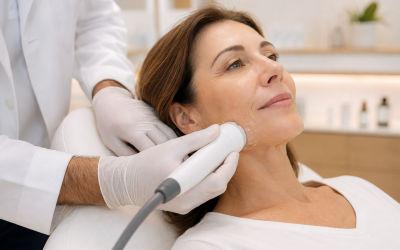
Radiofrequency, focused ultrasound, and certain laser-based systems may help reduce mild to moderate skin laxity in suitable patients.
Minimally invasive laser approaches such as Endolift may also be considered in selected patients.
Effectiveness, safety, and recovery vary by method.
Patients with significant skin sagging should not expect device-based treatments to produce results equivalent to a surgical facelift.
Surgical options such as genioplasty or a chin implant may be considered for patients with significant chin retrusion or structural asymmetry.
When bite misalignment accompanies a retruded lower jaw, orthodontic or jaw surgery assessment may be needed.
For advanced facial sagging and neck laxity, surgical options such as a face and neck lift may be considered.
Swelling, bruising, tenderness, and temporary contour irregularities may occur after injections.
Less common complications include infection, nodules, and asymmetry.
The lower face contains important blood vessels and nerves. Accidental injection into a blood vessel can cause serious tissue damage. Visual disturbances and other serious vascular complications have also been reported very rarely with filler injections.
Appropriate product selection, anatomical assessment, proper injection technique, and preparedness to manage complications are therefore important.
The first step is to identify which anatomical structures need to be addressed.
For a patient with a recessed chin, adding filler only at the jaw angles may not create a balanced profile.
Similarly, adding volume along the jawline alone may not achieve the expected result when fat beneath the chin is the main concern.
Treatment should therefore be planned to improve overall facial proportions.
At Dr. Armin Müştak’s private dermatology practice, chin and jawline assessment considers the facial profile, chin projection, jaw angle, skin quality, fat distribution, and neck contour together.
For suitable patients, fillers, collagen-stimulating treatments, botulinum toxin, and selected energy-based procedures may be considered based on individual needs.
When concerns are related to bone structure or advanced tissue sagging, patients are informed about relevant surgical options.
The central goal of chin and jawline treatment is a lower facial contour that complements the face’s natural anatomical balance.
Yes. A recessed chin can make the nose appear more prominent and alter the lower facial profile, particularly when viewed from the side. Assessment should also determine whether the recession involves the underlying jawbone or bite alignment.
No. Chin fillers generally aim to enhance the chin’s projection, height, or shape. Jawline fillers are used to define the contour of the lower jaw. Both areas should be assessed together.
They may help with mild loss of contour, but they cannot correct significant skin sagging on their own. Excessive filler can make the lower face look heavier in some patients. Skin laxity and fat distribution should also be assessed.
No single treatment is suitable for everyone. Options may include fillers or surgery for a recessed chin, botulinum toxin for width caused by enlarged muscles, fat-reduction treatments for fullness beneath the chin, and appropriate skin-tightening procedures or surgery for loose skin.

Aesthetic dermatology focuses on maintaining skin health, evaluating age-related changes,…
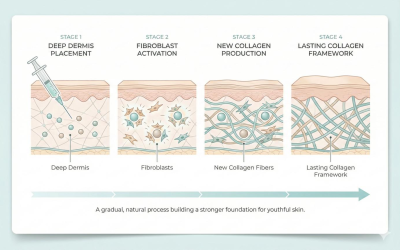
Poly-L-lactic acid (PLLA) is a biocompatible, biodegradable injectable material…
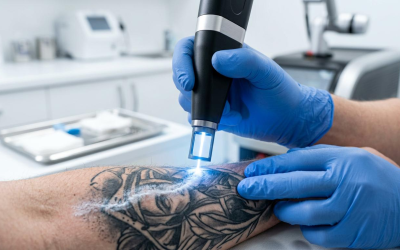
What Is Laser Tattoo Removal? Picosecond Laser Treatment Tattoos…
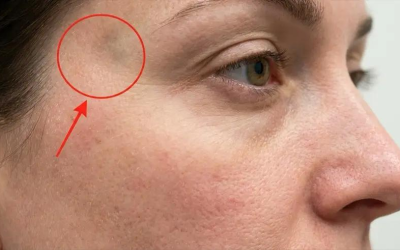
Facial aesthetics involves more than lip fullness, cheekbone definition, or…

The forehead forms the upper third of the face and…
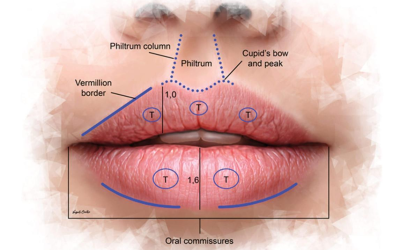
The lips play an important role in facial expression, the…
Fine red, purple, or bluish blood vessels on the face,…
Facial sagging describes changes in facial contours and soft tissues…

The eye area is one of the face’s most…

Laser hair removal is a light-based procedure designed…

Facial changes over time involve more than just wrinkles.…

Botulinum toxin is a medical product that temporarily reduces…

Dermal filler treatments are injection procedures performed to address…

PRP stands for "Platelet-Rich Plasma." A small sample of…
Fine red, purple, or blue veins appearing on the…
Mesotherapy involves the administration of small amounts of selected…
Radiofrequency treatments rely on generating heat within the skin…