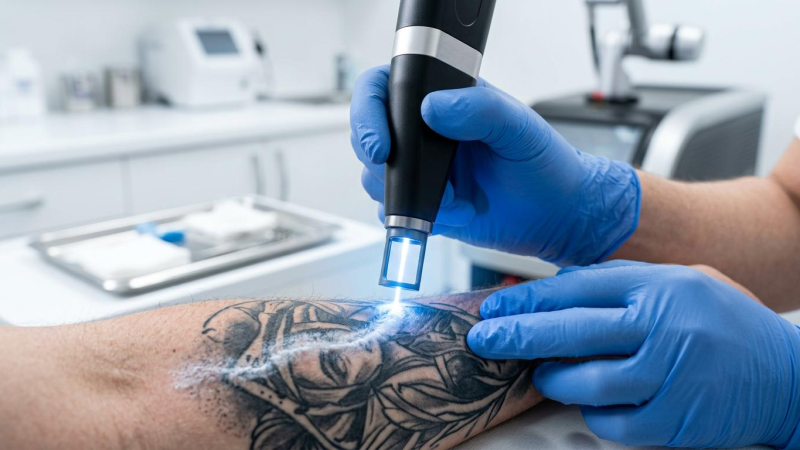
Tattoos are created by placing colored pigments in the dermis, the deeper layer of the skin. Because these pigments remain in the skin for a long time, tattoos are permanent.
Modern laser technologies can help fade unwanted tattoos or remove much of their visible pigment.
Picosecond laser systems are among the treatment options that target tattoo pigments with extremely short pulses of energy.
However, complete removal cannot be guaranteed. Results depend on the tattoo’s color, depth, size, ink composition, and the patient’s skin characteristics.
During laser tattoo removal, tattoo pigments in the skin absorb light energy.
This energy creates rapid mechanical effects that break pigment particles into smaller fragments.
Over time, immune cells help clear some of these fragments.
The tattoo therefore does not disappear completely during treatment. Fading may continue for weeks after each session.
Picosecond lasers deliver energy in extremely short pulses measured in trillionths of a second.
These short pulses can enhance the photoacoustic effect that breaks down tattoo pigment.
Key features of picosecond technology include:
However, using a picosecond laser does not make treatment completely painless or risk-free.
Dr. Armin Müştak’s private dermatology practice has a Picoson system that uses picosecond laser technology for tattoo removal.
This technology helps target and fragment pigment in suitable tattoos.
Before treatment, the tattoo’s color, size, depth, and location are assessed, along with the patient’s skin phototype.
Laser settings and the treatment plan are selected based on this assessment.
Tattoo color plays an important role in treatment response.
Black and dark inks: Generally respond better to laser treatment.
Red inks: Can be treated with lasers that use an appropriate wavelength.
Green and blue inks: May require different wavelengths depending on the pigment’s characteristics.
Yellow, white, and light-colored inks: Can be more resistant to treatment.
A single laser wavelength may not effectively remove every pigment in a multicolored tattoo.
Tattoo removal usually requires multiple sessions.
Factors affecting the number of sessions include:
Some tattoos may need only a few sessions, while densely pigmented or multicolored tattoos may require more.
The exact number of sessions cannot be guaranteed at the outset.
The skin needs time to heal after laser treatment, and the body needs time to clear fragmented pigment.
Sessions are commonly scheduled approximately 6–8 weeks apart or longer.
The appropriate interval varies with the tattoo’s characteristics, its location, and the skin’s response.
More frequent treatment does not necessarily produce faster or better results.
Laser pulses may cause brief stinging or burning, often described as similar to a rubber band snapping against the skin.
Discomfort varies depending on the tattoo’s location and size and the patient’s sensitivity.
Cooling and, for suitable patients, local anesthesia may be used.
Temporary whitening, redness, swelling, and tenderness may occur immediately after treatment.
Some patients develop blisters or crusting.
Less common effects include:
Risks vary depending on skin type, the laser used, and how treatment is performed.
Protecting the skin after treatment is important for healing.
Some permanent makeup pigments can be treated with lasers.
However, eyebrow, lip, and skin-colored camouflage pigments may contain substances such as iron oxide or titanium dioxide.
These pigments can darken unexpectedly after laser exposure.
Permanent makeup removal therefore requires a different assessment from conventional black tattoo removal.
Eye protection and careful patient selection are particularly important when treating the eyebrows and areas around the eyes.
Some tattoos can be removed completely or almost completely with laser treatment.
However, pigment composition, depth, and skin characteristics may leave residual color or a faint shadow.
The goal is to achieve the best possible pigment clearance while protecting healthy skin.
At Dr. Armin Müştak’s private dermatology practice, tattoo removal is planned according to the tattoo’s characteristics and the patient’s skin phototype.
Treatment using Picoson picosecond laser technology and other appropriate laser systems can be tailored to each patient’s needs.
Effective laser tattoo removal involves breaking down pigment while protecting the skin and allowing gradual, controlled fading.
Some tattoos can be removed completely or almost completely. However, results depend on the tattoo’s color, pigment density, depth, and skin characteristics. Complete removal cannot be guaranteed for every tattoo.
Multiple sessions are usually needed. Black tattoos and those with less dense pigment may respond more readily, while multicolored or professional tattoos may require more sessions. The expected number is estimated after an examination.
Appropriate technique can reduce the risk of permanent scarring, but it cannot eliminate it entirely. Temporary redness, crusting, and pigment changes may occur. Aftercare is important.
Picosecond lasers may break down pigment more effectively and require fewer sessions for some tattoos. However, they are not superior to other lasers for every color or every patient. The most appropriate system is selected based on the tattoo’s characteristics.

Aesthetic dermatology focuses on maintaining skin health, evaluating age-related changes,…
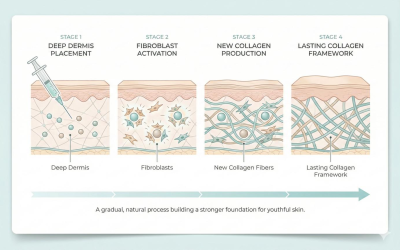
Poly-L-lactic acid (PLLA) is a biocompatible, biodegradable injectable material…
Facial aesthetics involves more than lip fullness, cheekbone definition, or…

The forehead forms the upper third of the face and…
The position of the chin in relation to the rest…
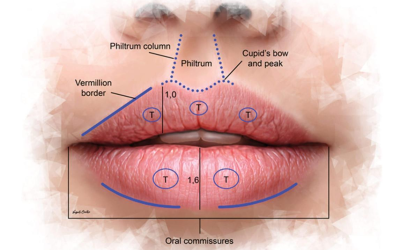
The lips play an important role in facial expression, the…
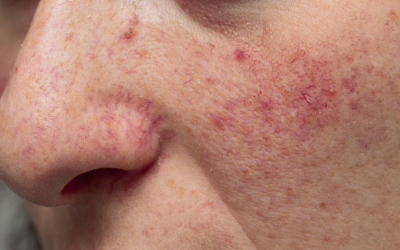
Fine red, purple, or bluish blood vessels on the face,…
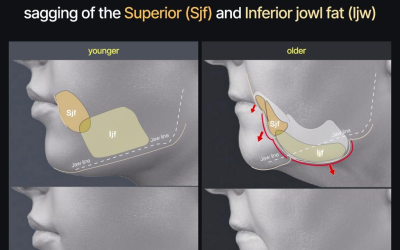
Facial sagging describes changes in facial contours and soft tissues…

The eye area is one of the face’s most…

Laser hair removal is a light-based procedure designed…

Facial changes over time involve more than just wrinkles.…

Botulinum toxin is a medical product that temporarily reduces…
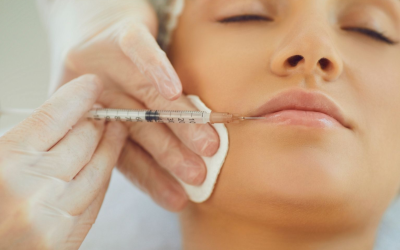
Dermal filler treatments are injection procedures performed to address…
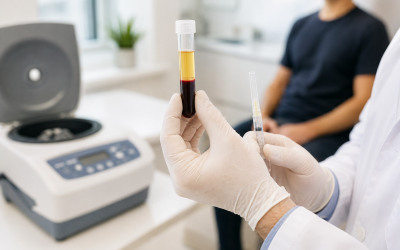
PRP stands for "Platelet-Rich Plasma." A small sample of…
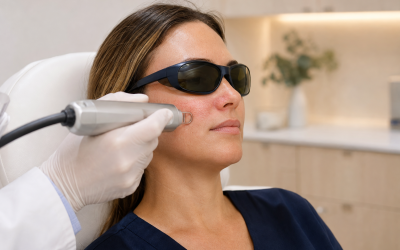
Fine red, purple, or blue veins appearing on the…
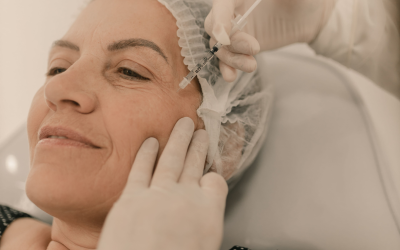
Mesotherapy involves the administration of small amounts of selected…
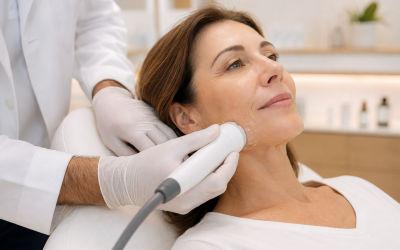
Radiofrequency treatments rely on generating heat within the skin…