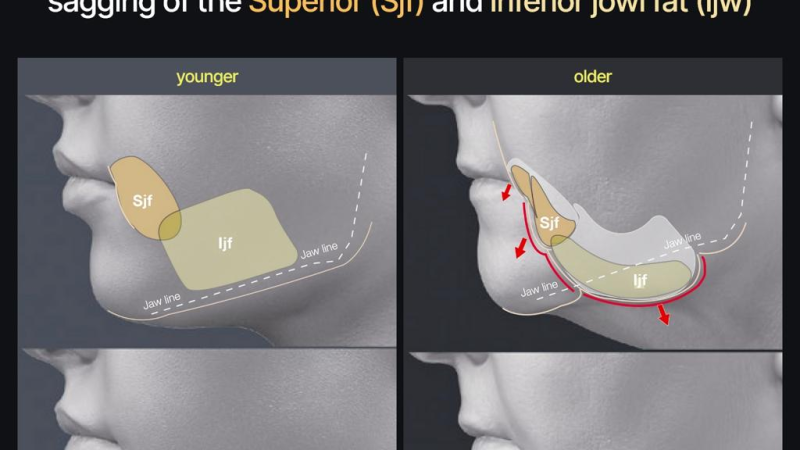
Facial sagging describes changes in facial contours and soft tissues that develop with aging.
Descending cheeks, reduced jawline definition, tissue fullness around the corners of the mouth, and neck laxity are common signs of facial aging.
However, facial sagging involves more than loose skin.
Bone structure, fat compartments, ligaments, muscles, and skin characteristics all need to be assessed together.
Facial aging is a complex process that affects several anatomical layers.
The main contributing factors include:
The extent and distribution of these changes vary from person to person.
Facial bones can remodel with age.
Changes around the eye sockets, upper jaw, and lower jaw may affect the support provided to overlying soft tissues.
For example, changes in the chin and mandibular contour can influence the appearance of the lower face.
However, bone changes do not occur to the same extent or in the same pattern in everyone.
Facial rejuvenation planning therefore considers the underlying anatomy as well as the skin’s surface.
Facial fat does not form a single continuous layer.
It is organized into superficial and deep compartments in different anatomical regions.
With aging, some areas lose volume, while others develop changes in fat distribution or prominence.
These changes may contribute to:
However, facial fat compartments do not all move downward in the same way over time.
Aging brings changes in the skin’s collagen, elastic fibers, and ability to renew itself.
Long-term sun exposure can accelerate this process.
Reduced skin elasticity may contribute to:
These changes may require different treatments from those used for volume loss.
Strong connective tissue structures called retaining ligaments help influence the position and movement of facial soft tissues.
They are an important part of facial anatomy.
However, ligament laxity alone does not fully explain facial aging.
Current anatomical research examines the relationships among supporting tissues, fat compartments, and bone structure.
Jawline definition depends on more than the shape of the mandible.
Chin position, skin laxity, superficial fat, and neck contour also play a role.
With aging, tissue bulges called jowls may develop on either side of the jawline.
Volume loss is the main concern for some patients, while loose skin or fat beneath the chin is more prominent in others.
Jawline fillers therefore do not produce the same result in every patient.
Aesthetic facial assessment includes front, profile, and three-quarter views.
Particular attention is given to:
Before treatment, the assessment identifies whether the main concern is volume loss, loose skin, excess fat, or a combination of these factors.
Facial rejuvenation procedures address different anatomical concerns. Treatment should therefore be selected according to each patient’s findings.
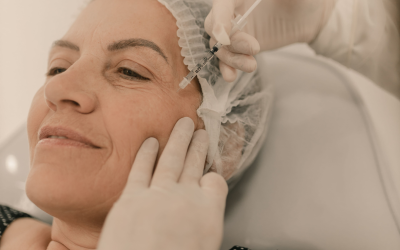
Hyaluronic acid fillers may be considered for suitable patients with volume loss.
They can provide structural support in selected areas of the midface, chin, and facial contours.
However, fillers cannot completely correct actual skin sagging.
In patients with significant sagging, excessive filler can make the face appear overly full or heavy.
PLLA is an injectable biostimulator intended to support the skin’s collagen production.
It may be considered for suitable patients with age-related volume loss and changes in skin structure.
Its effects develop gradually.
However, PLLA does not replace a surgical facelift.
Products containing CaHA may be used for volume support or collagen stimulation, depending on their formulation and how they are administered.
In selected patients, they may help support facial contours and improve skin quality.
Treatment areas should be selected according to the product’s properties and the patient’s anatomy.
Laser systems that operate at a wavelength of 1470 nm and use a thin fiber placed beneath the skin may be considered for tissue tightening and localized contouring in selected patients.
These procedures use the thermal effects of controlled laser energy on tissue.
They may be considered for certain concerns involving the lower face, jawline, and area beneath the chin.
However, Endolift is not suitable for every case of facial sagging.
Although clinical studies have reported favorable findings on effectiveness and safety, much of the research involves small patient groups. Stronger studies are needed to assess long-term outcomes.
Swelling, bruising, pain, or contour irregularities may occur after treatment. Improper treatment can cause burns, nerve injury, and other serious complications.
Fractional CO₂ laser may be considered for surface signs of aging and changes in skin quality.
It can help reduce fine wrinkles, sun damage, and certain superficial texture irregularities.
However, its primary purpose is not to reposition deeper facial tissues.
It may be insufficient on its own for significant cheek or jawline sagging.
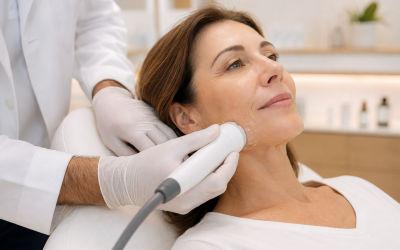
Energy-based treatments such as radiofrequency and focused ultrasound may help reduce mild to moderate skin laxity in some patients.
Results vary according to skin characteristics, the technology used, and the treatment area.
The degree of tightening is generally more limited than that achieved with a surgical facelift.
Botulinum toxin is primarily used to soften wrinkles caused by facial muscle activity.
It may also be considered to modify specific muscle activity in the lower face and neck in selected patients.
However, botulinum toxin alone does not correct facial volume loss or significant skin sagging.
A surgical facelift or neck lift may be more appropriate for patients with substantial excess skin and advanced tissue sagging.
In selected patients, surgery aims to reposition soft tissues and address excess skin.
Nonsurgical treatments should not be expected to provide the same degree or longevity of improvement as surgery.
No. Treatment selection should be guided primarily by anatomical findings and overall health rather than age alone.
For example, a younger patient may have significant volume loss, while an older patient’s main concern may be superficial wrinkles.
One treatment may be enough for some patients, while others may benefit from consideration of several approaches.
Avoiding unnecessary procedures and setting realistic goals are important.
Aging is a natural process and cannot be stopped completely.
However, regular sun protection, avoiding smoking, balanced nutrition, appropriate skin care, and avoiding rapid weight fluctuations can support skin health.
Topical retinoids and dermatologic resurfacing treatments may also help reduce visible signs of aging in some patients.
At Dr. Armin Müştak’s private dermatology practice, facial aging is assessed by considering skin quality, volume loss, fat distribution, jawline definition, and overall anatomical balance together.
For suitable patients, options may include hyaluronic acid fillers, collagen-stimulating treatments such as PLLA and CaHA, botulinum toxin, fractional CO₂ laser, and 1470 nm Endolift technology, based on individual needs.
For patients with significant tissue sagging, surgical treatment may be the more appropriate option.
Effective facial rejuvenation begins with identifying which anatomical layers have changed and how those changes affect the face.
No. In addition to reduced skin collagen and elasticity, changes in bone structure, fat compartments, and supporting tissues affect facial contours. An assessment of facial anatomy is therefore important before treatment.
The two approaches address different concerns. Fillers can help restore lost volume in suitable patients, while subdermal 1470 nm laser treatments may be considered for tightening and contouring in selected patients. The choice depends on the underlying cause of sagging.
With appropriate product selection and technique, PLLA and CaHA may stimulate collagen production and provide tissue support. However, they cannot correct significant excess skin or advanced facial sagging to the same extent as a surgical facelift.
Nonsurgical treatments may improve mild to moderate signs of aging in suitable patients. Results depend on the method used and individual skin characteristics. Surgery may be more appropriate for advanced tissue sagging.
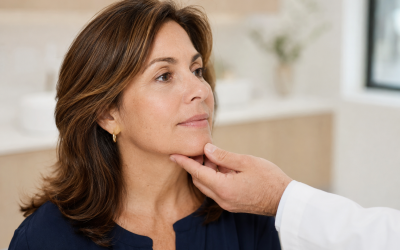
Aesthetic dermatology focuses on maintaining skin health, evaluating age-related changes,…
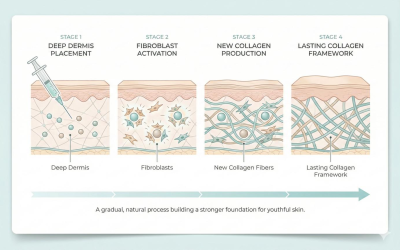
Poly-L-lactic acid (PLLA) is a biocompatible, biodegradable injectable material…
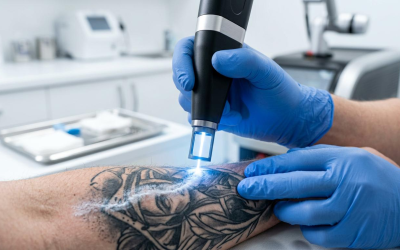
What Is Laser Tattoo Removal? Picosecond Laser Treatment Tattoos…
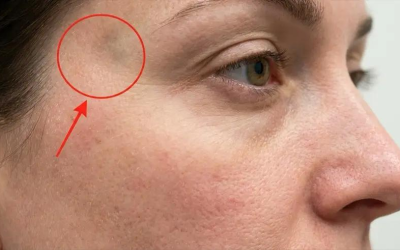
Facial aesthetics involves more than lip fullness, cheekbone definition, or…

The forehead forms the upper third of the face and…
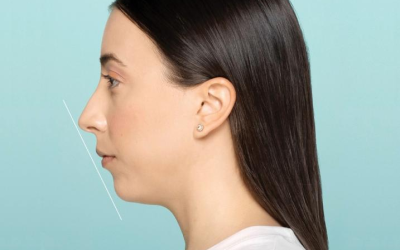
The position of the chin in relation to the rest…
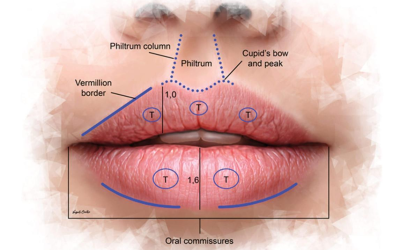
The lips play an important role in facial expression, the…
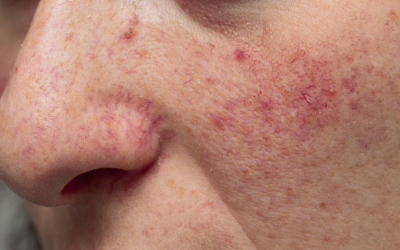
Fine red, purple, or bluish blood vessels on the face,…

The eye area is one of the face’s most…
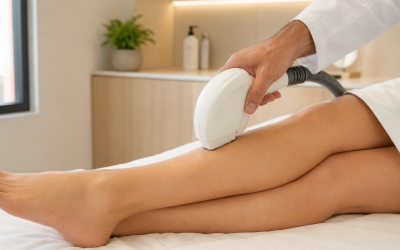
Laser hair removal is a light-based procedure designed…

Facial changes over time involve more than just wrinkles.…
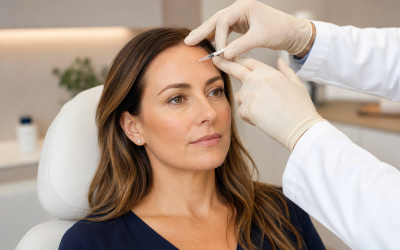
Botulinum toxin is a medical product that temporarily reduces…
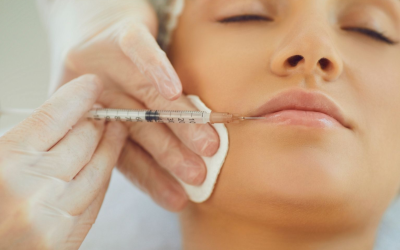
Dermal filler treatments are injection procedures performed to address…

PRP stands for "Platelet-Rich Plasma." A small sample of…
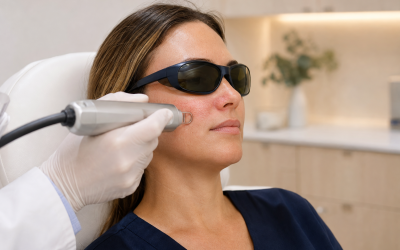
Fine red, purple, or blue veins appearing on the…
Mesotherapy involves the administration of small amounts of selected…
Radiofrequency treatments rely on generating heat within the skin…